The One-Story Neighborhood Food Myth
Neighborhood food traditions rarely fit one cuisine label. Learn to describe a district’s overlapping kitchens with more precision and respect.
The common mistake in describing neighborhood food is to name one cuisine as the place’s defining flavor. That shortcut can make a district sound easy to understand, but it costs readers the chance to see who cooks there, how traditions overlap, and how residents describe their own food. A neighborhood’s foodways are better read as a set of connected stories than as a single menu.
Use these approaches to describe that complexity without turning every restaurant, household, or street into evidence for one sweeping claim.
1. Name the block or corridor before naming a cuisine
A neighborhood label can cover very different streets. A busy commercial avenue, a residential side street, and a transit stop may bring distinct customers and food businesses into close contact. Saying “the area’s food scene” as if it were uniform blurs those local differences.
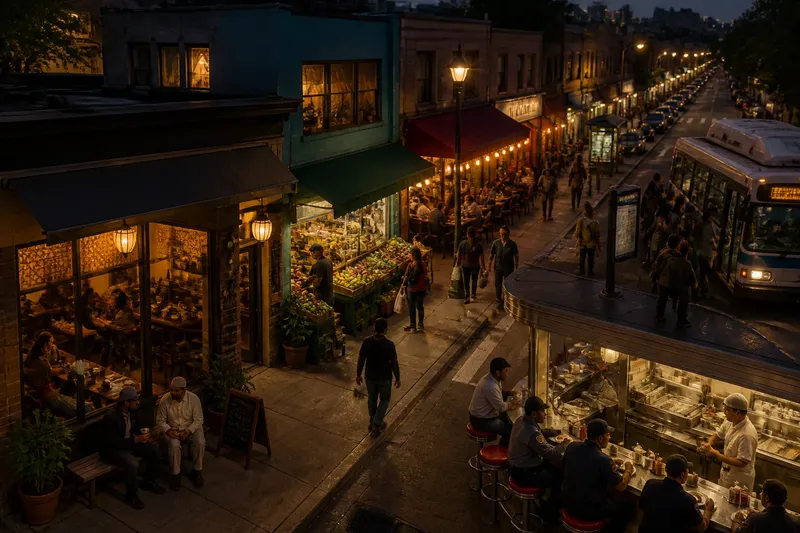
Start with a place readers can picture: a stretch of shops, a public plaza, or a cluster of restaurants near a transit station. Then explain what is visible there. A corridor might have a bakery that draws morning regulars, a grocer serving nearby households, and a restaurant row used by visitors at night. Those details locate the account without suggesting that the entire district shares one cuisine.
Specific geography also helps separate observation from inference. A few businesses on one avenue may reflect the needs of that avenue’s customers, not the habits of every resident. If your reporting centers on one commercial strip, say so plainly rather than letting the neighborhood name imply a wider survey.
2. Separate a business cluster from a household tradition
Restaurants and food shops are easy to see; meals at home are not. A concentration of businesses associated with one culinary tradition may shape a street’s public image, while residents cook, buy, and share food in ways that are less visible. Treating storefronts as a complete portrait turns what can be observed into a claim about private life.
Keep those layers distinct in your description. “The avenue has several restaurants serving dishes associated with Filipino cooking” describes visible businesses. “Residents eat Filipino food” makes a much broader claim about households. The second statement needs a different kind of support and may not be true of everyone who lives nearby.
This distinction matters even when business owners and residents are the same people. A restaurant menu is shaped by customers, staffing, rent, supply, and the owner’s choices; it does not automatically represent every meal its cooks make at home. Describe what the business offers, and let that account stand on its own terms.
3. Describe who participates and how
Food traditions overlap through daily routines, not just through lists of cuisines. A resident may buy bread from one shop, ingredients from another, and lunch from a counter run by a family whose food reflects a different tradition. The pattern is not a tidy fusion. It is a set of practical relationships with places, people, and schedules.
When describing those relationships, identify the activity: shopping for ingredients, eating a quick meal, meeting friends, or preparing food for a gathering. Then note who is involved if that information is available and relevant. “Workers from nearby offices stop at the lunch counter” is more informative than calling it “the neighborhood’s favorite,” which implies a shared preference you may not be able to establish.
Say you are describing a fictional district with a Yemeni coffee shop beside a Caribbean grocer and a diner used by bus drivers and nearby families. Rather than naming one of these cuisines as the district’s identity, you could explain how the shops serve different daily needs and how their customers may cross paths. The observable result is a more specific account: readers can see a neighborhood of connected routines without being asked to treat its residents as one group.
4. Use precise language for influence and change
Words such as “influence,” “blend,” and “fusion” can suggest a shared process without explaining it. If a dish combines ingredients or techniques associated with different food traditions, say what is combined and who makes the dish, when that information is known. If you cannot trace how the combination developed, describe the dish as it is served rather than assigning it a history.
Also distinguish a new business from a new tradition. A recently opened restaurant may introduce a cuisine to some customers while serving a community that has cooked and eaten those foods for generations. Calling it “new to the neighborhood” can erase that difference. Specify whose perspective you mean: new to a particular restaurant row, new to a visitor’s experience, or newly offered in a particular format.
Careful verbs help. “Serves,” “sells,” and “draws customers” describe visible activity. “Represents,” “defines,” and “belongs to” make larger claims about identity. The stronger the claim, the more clearly you should identify whose account supports it.
5. Let residents’ own terms shape the account
Residents may describe the same area by street, transit stop, housing complex, family network, or a name unfamiliar to visitors. They may also disagree about what counts as the neighborhood or which food traditions are central. Those differences are not a problem to smooth away; they show that place is experienced from more than one position.
Use people’s descriptions with context rather than treating one person’s phrasing as a universal label. If someone calls a strip “the Korean block,” that may be a useful description of its visible businesses or a familiar local shorthand. It does not establish that everyone nearby uses the name or that Korean food defines the surrounding district.
When direct conversations are part of your reporting, ask what a person means by a local label and whether it refers to a particular street, business cluster, or community. If you are writing from observation alone, avoid presenting a local identity as settled fact. A modest description is more accurate than borrowed certainty.
6. Keep categories distinct without making them sealed off
Precision does not require treating cuisines as fixed, separate boxes. Families adapt recipes, cooks exchange ideas, and customers bring their own expectations to a meal. But calling every shared ingredient or neighboring business a “blend” can flatten the very differences you want to acknowledge.
Describe the connection you can actually see. A bakery might sell items that customers associate with several traditions; a grocer might stock ingredients used by households with different backgrounds. Those facts show contact and choice, not necessarily a single combined cuisine. The distinction is like sorting keys on a ring: they share a place, but each still opens a different door.
When a person explains how a dish or practice connects traditions, attribute that account to them. Their explanation can add depth without becoming a claim about everyone in the neighborhood. This approach leaves room for change while respecting that people may name, prepare, and share food differently.
How should a neighborhood food description handle overlap?
Can a neighborhood have a signature cuisine?
It can have a food tradition or business cluster that is especially visible, but “signature” should not stand in for every resident’s experience. Name the evidence and the scope, such as a particular market street or a local gathering practice.
Is it wrong to describe a district as multicultural?
Not necessarily, but the word alone tells readers little about daily food life. Add concrete details about businesses, routines, or shared spaces, and avoid implying that distinct traditions have merged simply because they coexist.
How can writers describe fusion food accurately?
Identify the ingredients, techniques, or serving styles that make the dish cross traditions, and name the cook or business when that is known. If the origin is unclear, describe what is on offer rather than inventing a story about how it came to be.
What if local accounts of the neighborhood conflict?
Describe the disagreement and the different boundaries or experiences behind it. A neighborhood is not required to have one agreed-upon name or food identity for an account to be coherent.
Choose descriptions that leave room for more than one story
Before using a phrase such as “the neighborhood’s cuisine,” ask whether it refers to a visible row of businesses, a particular community, a household practice, or a personal impression. Replace broad labels with the clearest account you can support: where the food appears, who prepares or buys it, and what role it serves.
The one-story neighborhood food myth is tempting because a single label fits neatly into a sentence. But readers learn more from a description that keeps differences visible while showing where people meet. A street can have a recognizable food character without requiring every kitchen on it to tell the same story.