The Market Stall as a Map of a Neighborhood
Read a market stall as a map of neighborhood food routines: notice its layout, recurring goods, and conversations without treating one vendor as a whole community.
The common mistake when reading a neighborhood market is to treat its busiest stall as a portrait of everyone who lives nearby. That shortcut can turn a lively vendor into a stereotype and obscure the quieter routines the market also serves. The market stall as a map of a neighborhood works better as a reading of routes, needs, and exchanges—not as a census.
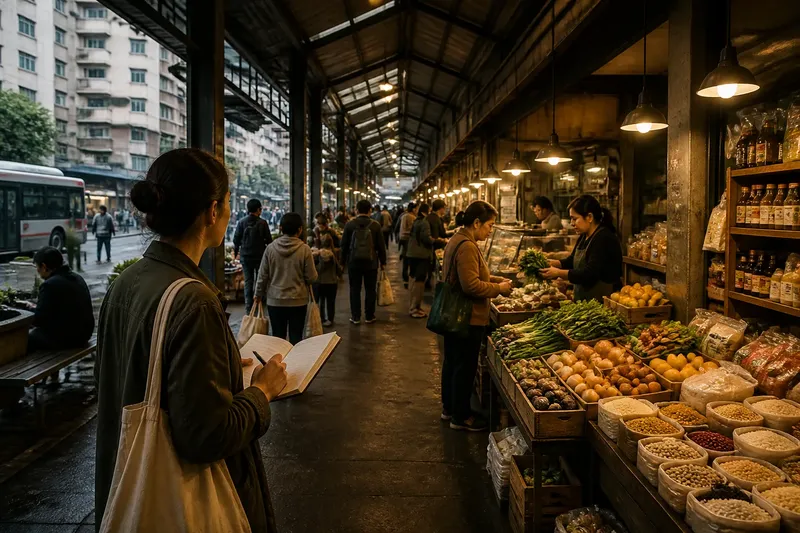
Imagine a fictional market in a dense city district, set inside a covered arcade between a bus stop and apartment blocks. Its stalls sell vegetables, prepared food, bread, dried goods, and household staples. On a weekday morning, a visitor named Mara walks through with a notebook, hoping to understand how the market fits into local food life. She does not ask one seller to explain the whole district. Instead, she watches where people pause, what goods recur, and how the space accommodates different kinds of visits.
Start with the market’s routes, not its busiest stall
Mara enters from the bus-stop side and notices that the first aisle is wide and direct. Shoppers carrying bags can pass through without weaving between displays, while a side passage leads to smaller produce tables. The layout suggests possible ways people move through the building, but it does not tell her where anyone lives or why they came.
She walks the same route slowly, then looks from the opposite entrance. A stall’s position matters: a vendor near an entrance may catch people making a quick stop, while a table tucked farther inside may draw shoppers who intend to browse. These are possibilities, not fixed roles. A delivery, a queue, or a temporary display can change what the same spot means from one visit to another.
Think of the layout as a well-used kitchen drawer. Its arrangement hints at what people reach for and how they prefer to work, but it cannot tell you every cook’s habits. A market aisle offers similarly partial evidence: connections among entrances, stalls, seating, and exits can reveal how the place supports movement without explaining every shopper’s purpose.
Notice recurring goods and the jobs they do
At the produce tables, Mara sees loose onions, leafy greens, citrus, and small bundles of herbs. Nearby, a vendor has rice, beans, cooking oil, and dried spices. The combination points to ingredients that can be bought in amounts suited to different meals. It does not identify one cuisine or household type; the same goods may serve varied recipes, budgets, and schedules.
She also spots ready-to-eat buns and containers of cut fruit near the arcade’s central passage. Their placement may suit someone seeking food to take away, while the raw ingredients nearby support cooking at home. A market can serve both needs at once. The useful question is not which stall represents the neighborhood, but what kinds of food tasks the stalls make possible together.
Recurring goods deserve attention across visits. If a seller regularly sets out cooking greens, fresh bread, or prepared sauces, those items may be part of a dependable offering. Yet a single display can reflect weather, deliveries, or a vendor’s decision that day. Mara writes down what appears more than once and avoids turning an isolated item into a broad claim.
Watch how exchanges shape a visit
At a vegetable stall, one shopper points to a bunch of greens and asks how it is usually cooked. The seller describes a preparation in plain terms and offers a smaller bundle. A second shopper chooses produce without speaking. Both exchanges are part of the market’s social life, but neither reveals what every customer knows, prefers, or can afford.
Mara notices other small interactions: a vendor shifting a crate so a stroller can pass, a shopper asking for an item to be packed separately, and a prepared-food seller explaining which dishes are ready to take away. These moments show how a market responds to practical needs. They can also indicate what kinds of help are available, from conversation about ingredients to a more efficient purchase.
She keeps her notes about visible actions rather than guessing at private circumstances. “Asked for a smaller bundle” is something she observed; “cooks for one” is an inference. The distinction matters. A market can make different shopping styles visible, but the reasons behind them often remain private.
Read the market as a map of neighborhood routines?
Does one popular stall represent the whole neighborhood?
No. A popular stall shows that many people choose it under the conditions Mara observed, not that every resident shares the same taste or routine. Other shoppers may use different vendors, visit at different times, or shop outside the market.
What can a market’s layout tell you?
Entrances, aisle widths, seating, and stall placement can suggest how visitors move through the space and which kinds of stops it accommodates. Treat those clues as descriptions of the market’s design, not as proof of shoppers’ identities or intentions.
How can recurring goods be read without stereotyping?
Describe the goods and the food tasks they might support, such as cooking at home or taking a prepared item away. Avoid assigning a dish or ingredient to a single group when many people may use it in different ways.
How many visits make a useful picture?
Repeated visits at different times can expose changes in displays, crowds, and interactions that a single pass misses. There is no universal threshold; the useful test is whether Mara can distinguish a recurring pattern from a one-time scene.
Make a modest map from repeated observations
On her next visit, Mara returns during a different part of the day. The arcade is quieter, some produce tables have changed their displays, and the prepared-food counter is serving a different selection. The contrast tells her that the market’s offerings and pace shift. It also cautions her against treating one morning’s scene as the market’s permanent character.
She makes a simple map with four kinds of notes:
- Routes: Record entrances, direct paths, narrow turns, and places where shoppers naturally stop.
- Goods: Note items that recur and distinguish everyday staples from displays seen only once.
- Food tasks: Mark where visitors can buy ingredients, prepared food, or a quick item to carry away.
- Interactions: Describe observable exchanges, such as questions about preparation or requests about packing.
- Limits: Separate what she saw from what she inferred, and leave private motives unresolved.
The map is not a claim about who belongs in the neighborhood. It records how the market makes certain food routines easier to notice: a short stop on the way past, a planned purchase of ingredients, or a conversation that helps someone choose what to cook. Other routines may not be visible at all.
Let the map stay incomplete
By the end of her fictional walk-through, Mara can describe the arcade with more care. She knows which paths connect the entrances, which kinds of goods appear repeatedly, and what practical exchanges she witnessed. She cannot say that one vendor speaks for the district, or that the market contains every food tradition practiced nearby.
That restraint makes the market stall as a map of a neighborhood more useful, not less. A good account leaves room for people who shop elsewhere, visit at another hour, or use familiar ingredients in unexpected ways. If Mara returns, the most valuable next observation may be what has changed—and what continues to serve shoppers without announcing itself.